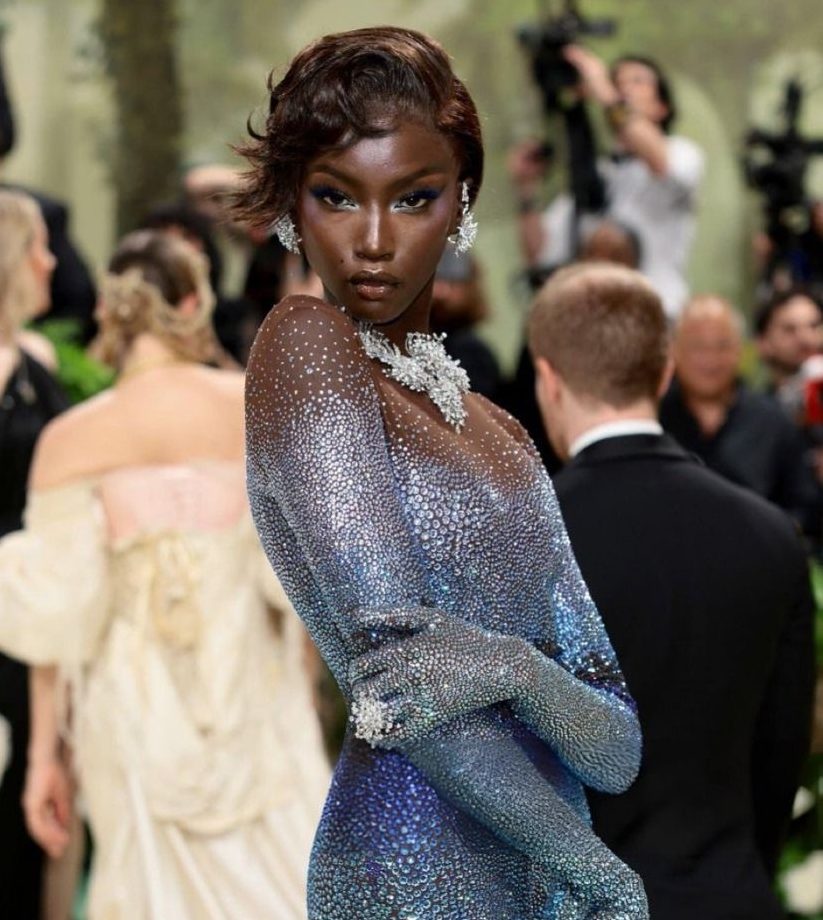
“Swan Song”: Adut Akech at the Met Gala, Outfit Breakdown
There’s a particular hush that falls over the Met Gala’s digital audience when a look arrives that is so complete, so conceptually sound, that it momentarily breaks the internet’s ability to simply ‘like’ it. Instead, we just… absorb. We stare. We zoom in. This wasn’t just another celebrity in a pretty dress; this was Adut Akech, a vision in sculptured pink and a cascade of feathers, offering a masterclass in what it means to not just wear history, but to rewrite it in real-time.


To understand the weight of this moment, you have to remember what it used to be like. Rewind the tape. For decades, the narrative of high fashion and its most hallowed red carpet was a monologue, not a dialogue. Black women, when they were granted entry at all, were often styled as an afterthought, forced into a Eurocentric ideal of glamour that rarely made room for their specific brilliance. They were presented as beautiful, sure, but rarely as the oracles of style they are.
The conversation, if you could call it that, was perpetually defensive. It was about “proving” they belonged, about navigating a landscape that was often openly hostile to their features, their hair, their skin tone. The goalposts were always moving. Too bold? You’re gaudy. Too simple? You’re not trying. The glamour was conditional, a loan extended hesitantly from an institution that didn’t see them as its native heirs.
Adut Akech didn’t step onto those hallowed steps to ask for a seat at the table. She arrived as the queen whose table it has always been.
Her look, a custom Swarovski masterpiece under Giovanna Engelbert’s direction, was so much more than a dress. It was a manifesto in crystal and silk. Let’s break down why this moment felt like a tectonic shift.
The Silhouette: A Dialogue Between Power and Poetry

The Silhouette: A Dialogue Between Power and Poetry
The genius of the construction lay in its duality. The base was a sharp, gilet-inspired mini dress, all structure, confidence, and modern authority. This was the suit of armor, the tailored strength that echoed the dandyism and rebellious spirit the theme demanded. It said, “I am here on my own terms.” But flowing behind it was that magnificent, floor-sweeping tailcoat, a train of pure, unadulterated drama. It was the whisper after the declaration, the grace note that gave the power room to breathe.
And then, the collar. Oh, the collar. Let’s be clear: this was no mere accessory. This was the crown. A monumental crest of feathers and organza, hand-encrusted with a galaxy of over 25,000 Swarovski crystals, it framed Adut’s face like a halo. It evoked the elegant, formidable arch of a swan’s neck, not a fragile bird, but a creature of myth, mid-metamorphosis. It was at once regal and untamed, structured and soft. It was the perfect contradiction, and on her, it made perfect sense.
The Alchemy: Where Craft Meets Concept
This vision was born from a true meeting of the minds. This wasn’t a stylist pulling a dress; this was a collaboration between Adut, a muse of innate, queenly gravitas, and Giovanna Engelbert, a creative director with the visionary chops to translate a big idea into a wearable, walkable reality.

The stories that trickled out from the atelier afterwards are the stuff of fashion legend. A small team of artisans, their hands possessing a preternatural patience, labored for hundreds of hours. Imagine the silence of that room, punctuated only by the precise placement of each tiny crystal. Each one was a decision, a point of light in a constellation designed to capture every flashbulb, every glance. This is the hidden world of true haute couture, a level of labor so intense it transforms clothing from mere garment to cultural artifact.
The Resonance: Why This Felt Like a Reckoning
But why did this specific look feel so different? Why did it feel like a door was not just opened, but kicked off its hinges?
It answered the Gala’s theme, Superfine: Tailoring Black Style, with a nuanced, intellectual depth that many others missed. American style is irrevocably Black style. It is the innovation born of necessity, the glamour forged in resilience. Adut’s look pulled from the tailored authority of menswear, a domain Black dandies have used for centuries to command respect and assert dignity in a world that denied them both, and fused it with a lyrical, avian softness.
It was armor and adornment in a single breath. It spoke of the “crafted self,” the idea that identity is both inherited and built, a suit of armor we design to face the world, beautifully and on our own terms. For a Black woman, this is not a fashion concept; it is a lived reality. She wore that truth.

A Brief Word on The Glow: The Canvas Behind the Masterpiece
You can’t talk about a look this commanding without mentioning the woman wearing it. Adut’s beauty look was a lesson in brilliant restraint. Her team knew the assignment: the outfit was the soloist; everything else was the orchestra, there to support, not overpower.
Her skin, that legendary, “lit-from-within” radiance, was the star. For our readers, know this: that glow is not genetic luck (though it helps); it’s a ritual. It’s built on weeks of relentless hydration, gentle exfoliation, and strategic layering of vitamin C and barrier-supporting moisturizers. The day-of magic comes from a dewy primer and a liquid illuminator meticulously dabbed on the high points to catch the light. It’s a polished, perfected canvas that allows the art to shine.

The Final Word: A Legacy Moment
This was more than a red carpet win. This was a historical correction.
Adut Akech didn’t just wear a beautiful dress. She wore a narrative of power, transformation, and unapologetic Black excellence. She connected the dots from the unsung Black style innovators of the past to the radiant present, asserting a right to the spotlight that is innate, not given.
She showed us that the future of glamour is intelligent, it is crafted, it is deeply personal, and it is, unquestionably, royal. The conversation is no longer about getting a seat at the table. It’s about realizing you’re the one the table was built for all along.